Urine Specimen Cup Redesign
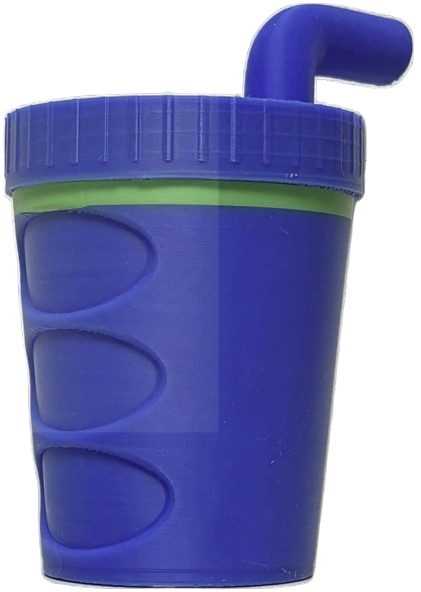
Could a water bottle inspire a urine cup? Yuck — maybe it’s better to first ask if it even should. But my line of thinking started with, “What are common items that may have been modified to make it easier for people with hand or finger impairments to use?” The ultimate challenge my BMED 1000 group and I aimed to address was the difficulty of holding and screwing or unscrewing the cup that individuals with hand and/or finger impairments face. So, a natural parallel to the urine cup was a water bottle. I was confident that someone must have already modified the water bottle to make it easier for others to use. But who, and how? Could the modifications even be useful?
For the most complete picture of our project, see our group’s final report by clicking on the link in the left sidebar.
Problem Statement
Patients with finger or hand impairments need to hold and screw/unscrew the urine cup in order to independently be able to provide urine samples because greater autonomy reduces the potential embarrassment or guilt associated with relying on others.
User Story
A seventy-year old male with arthritis, Hubert, is requested to provide a urine sample for a urinalysis test, but he struggles to collect the sample without feeling immense pain in his hands and fingers. However, Hubert is determined to collect the sample on his own. Because of his arthritis, he struggles to grasp the cup. Eventually, he must ask the doctor for help and feels dissatisfied that something that should be so easy is so much more difficult for him.
Why We Chose This Project
In our research, we found three important unmet needs that strongly influenced user experience and diagnostic reliability:
- inclusivity across patient populations for use,
- comfort and minimization of splashing, and
- tamper prevention for sample integrity.
We chose to focus on the first one. Due to struggles with grip (due to finger mobility issues, perhaps), dexterity, or understanding the instructions (due to developmental or neurological disabilities, for example) many patients report experiencing medical distress or shame during sample collection. This occurs because the aforementioned struggles lead to a loss of autonomy; caregivers or family members have to assist the patients in collecting urine samples. This loss of autonomy is what ultimately leads to shame and guilt. In fact, it has been well-documented that a loss of independence is associated with feelings of guilt and being a burden. Kristin Beale, a wheelchair user and someone who has been around others with disabilities such as paralysis, says she’s heard several people “express the sentiment of being a ‘burden’” (source). And, according to the article titled “Burden vs. Entitlement…,” most people with disabilities “struggle with the balance of feeling like a burden and feeling entitled to accommodation and help” (source).
My Contributions
- Designed the 3D CAD models for the cup and lid; 3D-printed multiple iterations of each part to best allow us to test our prototype. The physical parts helped us gain a firsthand understanding of how our proposed design changes could improve patient experiences in the future.
- Refined and strengthened our problem statement by advocating to expand our target patient group slightly, restructuring the statement’s wording, and improving its brevity.
- Collaborated with my team of four to brainstorm ideas, identify user needs, and work through the FDA design waterfall.